
- You are here:
- Home »
- Rubber Expansion Joint
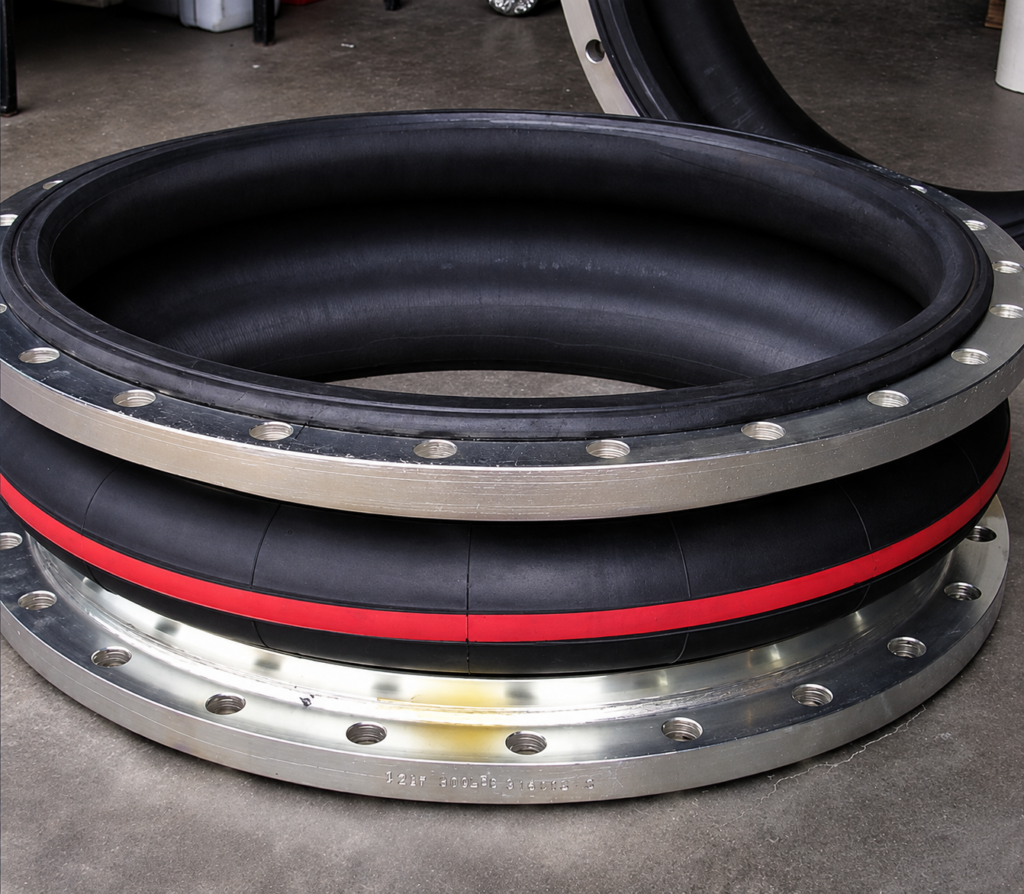
Rubber Expansion Joint
Rubber Expansion Joint combines a single-sphere elastomeric body, polyester-cord reinforcement and loose flanges to form a flexible connection between piping and equipment. The reinforced rubber sphere deforms under relative pipe movement to accommodate axial compression and extension, lateral displacement and limited angular movement, while its elasticity helps reduce vibration and structure-borne noise from pumps, compressors and connected equipment. This construction is particularly suitable for pump inlet and discharge connections, circulating-water systems, HVAC equipment interfaces and industrial piping sections where vibration or relative movement cannot be carried effectively by a rigid connection.
For industrial service, a single sphere rubber expansion joint cannot be selected by nominal pipe size alone. The process medium determines the required inner rubber compound, while operating pressure and temperature, required movement, flange interface, installation alignment and piping restraint determine whether the joint can operate within its intended deformation range. Pressure thrust and external piping loads must also be controlled by the surrounding piping system; the flexible body is intended to absorb specified movement and vibration rather than compensate for severe installation misalignment.
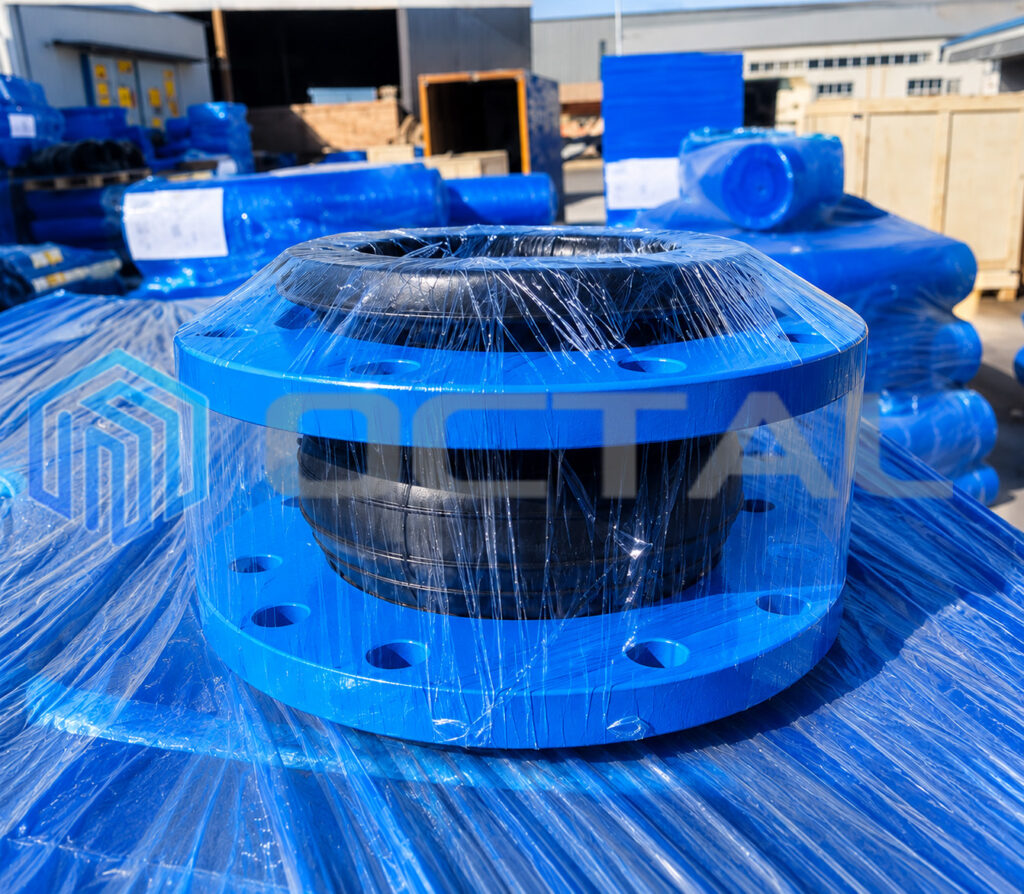
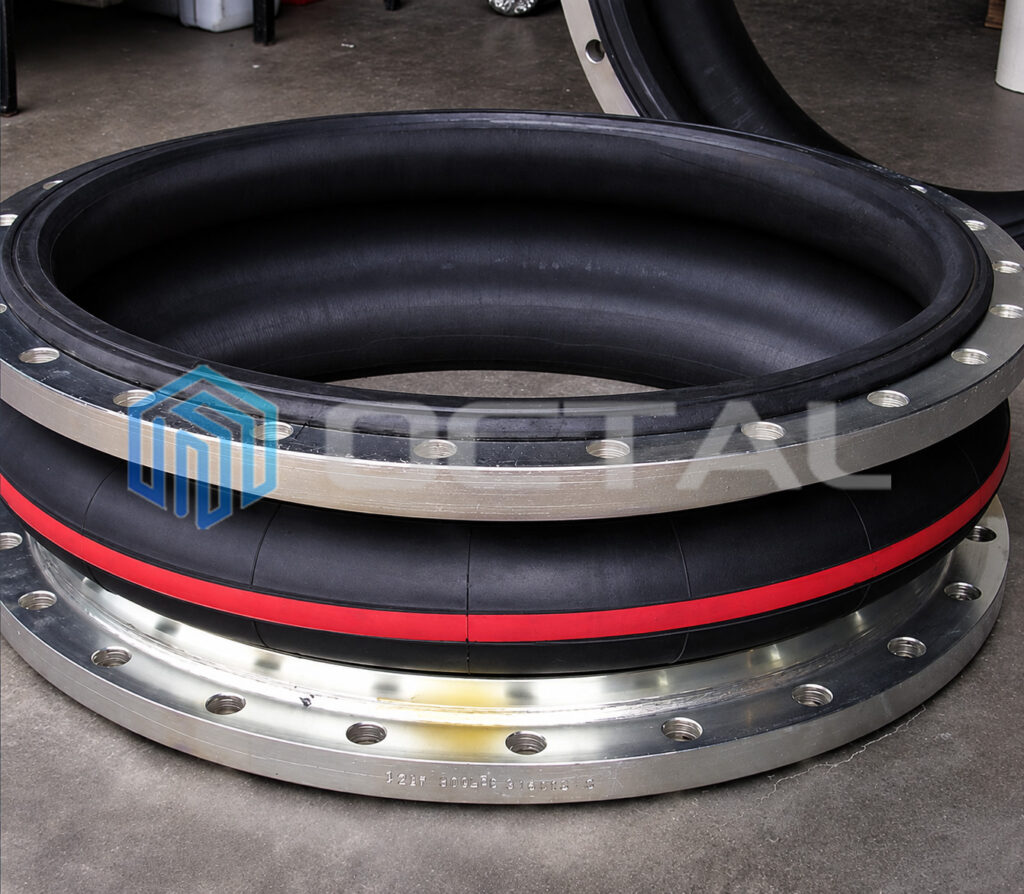
OCTAL STEEL supplies flanged rubber expansion joints with a reinforced single-sphere construction for industrial piping and equipment connections. The current product reference is PN16, 5 in. (DN125) and uses an inner rubber layer for media containment, polyester cord fabric for pressure reinforcement, an outer rubber layer for environmental and mechanical protection, and rotatable loose flanges for easier bolt-hole alignment during installation. Rubber material should be matched to the service medium: EPDM is suitable for water and many polar-media applications, while NBR or another compatible elastomer should be considered where oil, fuel or hydrocarbon resistance is required.
Single Sphere Flanged Rubber Expansion Joint Configuration
The single-sphere construction places one flexible elastomeric arch between the two pipe connections. Compared with a rigid spool piece, this flexible section can deform under relative pipe movement instead of transferring the entire displacement directly into the connected equipment or adjacent piping.
The loose flanges provide the mechanical connection to the piping system and can rotate during installation to assist bolt-hole alignment. The rubber sphere remains the active flexible element; the flange itself does not provide the movement compensation.
| Item | Reference Product Configuration |
| Product | Single Sphere Rubber Expansion Joint |
| Construction | Single sphere |
| Connection | Flanged |
| Reference Pressure Designation | PN16 |
| Reference Size | 5 in. / DN125 |
| Flexible Element | Reinforced rubber composite sphere |
| Internal Layer | Service-selected rubber in contact with the medium |
| Reinforcement | Polyester cord fabric |
| External Layer | Protective rubber cover |
| Flange Arrangement | Loose / rotatable flange |
| Main Functions | Vibration isolation and axial, lateral and angular movement accommodation |
These values describe should not be interpreted as the complete size, pressure or movement range of every rubber expansion joint configuration.
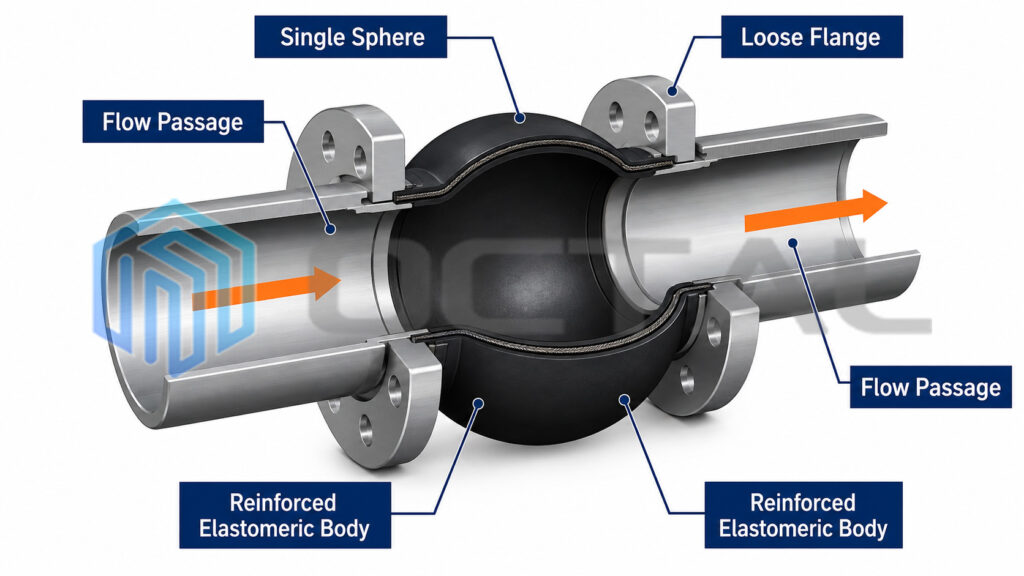
Rubber Expansion Joint Movement and Vibration Control
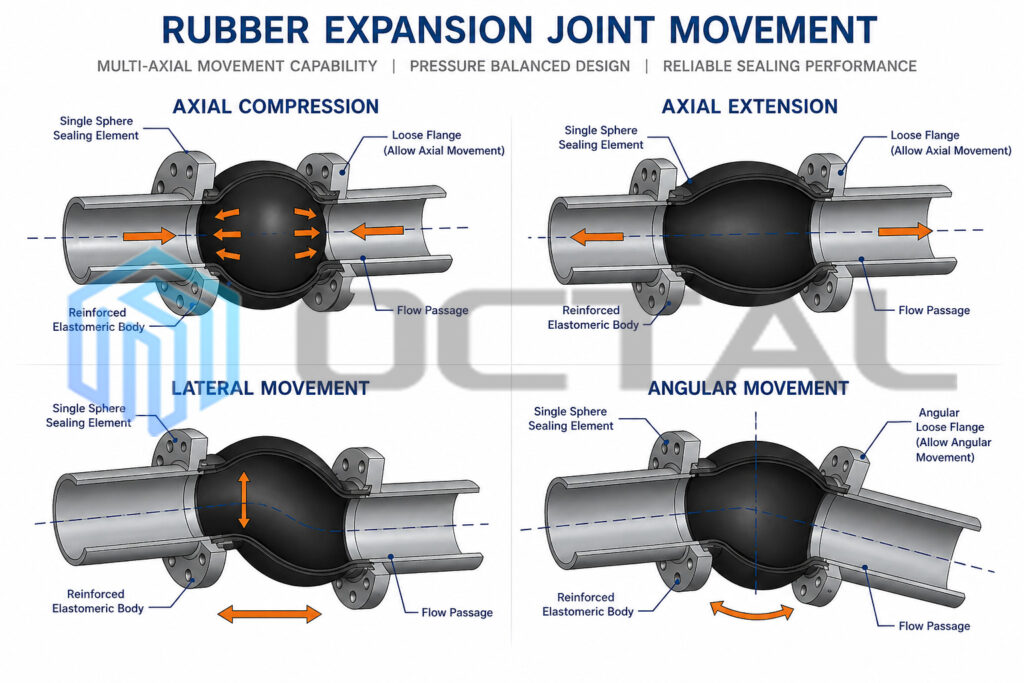
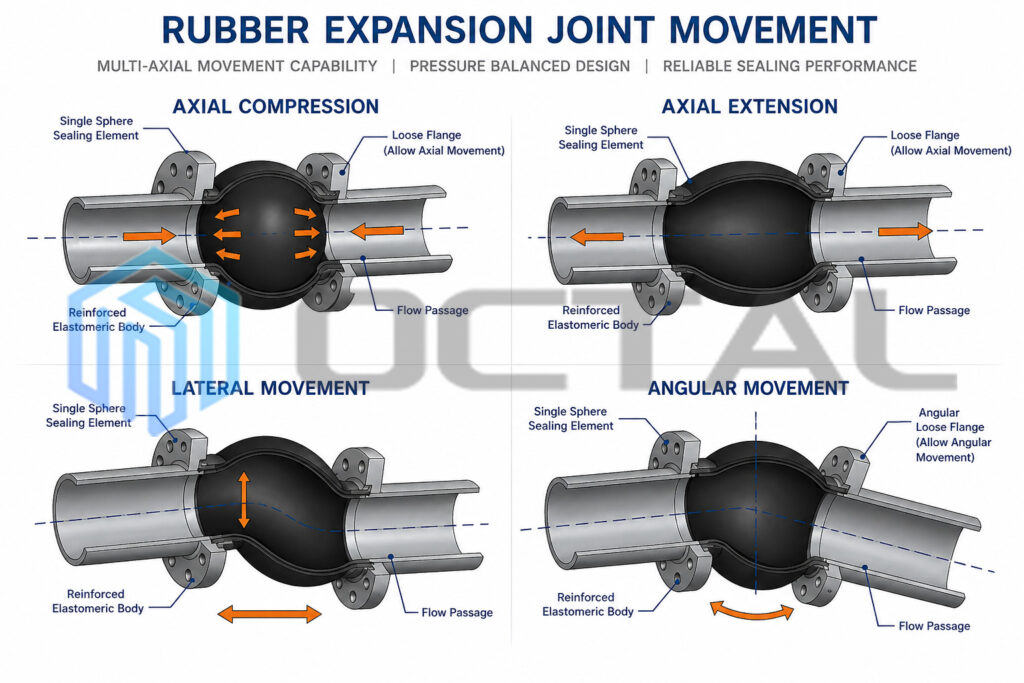
A rubber expansion joint accommodates piping movement through controlled deformation of its reinforced elastomeric sphere. The rubber body changes shape as the connected pipe ends move, while the reinforcement restrains excessive expansion and helps the joint maintain pressure integrity. The amount of movement that can be accepted depends on the actual joint size, construction and operating condition.
Axial Compression and Extension
Axial movement occurs along the pipeline centerline. When the distance between the two mating flanges decreases, the rubber sphere compresses; when the distance increases, the sphere extends within its specified movement range. This allows the joint to absorb limited dimensional changes caused by thermal expansion, equipment movement or piping displacement without transferring the full movement into a rigid connection.
Lateral and Angular Movement
Lateral movement occurs when one flange shifts sideways relative to the other while their centerlines remain generally parallel. Angular movement occurs when the two connected pipe sections rotate slightly relative to each other. The flexible sphere can deform to accommodate these movements, but the joint should not be used to correct excessive installation misalignment or piping that has been forced out of position.
Vibration Isolation Between Equipment and Piping
In pump, compressor and other rotating-equipment connections, the elastomeric body also acts as a flexible break in the mechanical load path. Instead of transmitting vibration directly through a rigid pipe connection, part of the movement is absorbed by repeated elastic deformation of the rubber and reinforcement layers.
This makes the joint particularly useful near pump suction and discharge lines, circulating-water equipment and other piping interfaces where vibration isolation and movement accommodation are required at the same connection point. Piping anchors, guides and restraints must still be designed separately because the rubber joint does not eliminate pressure thrust or uncontrolled pipe movement.
Construction of an Industrial Rubber Expansion Joint
The apparent rubber sphere is actually a composite pressure-containing structure. Each layer performs a different function, and the complete construction must remain flexible while resisting the internal medium and operating pressure.
| Component | Function in the Joint |
| Inner Rubber Layer | Directly contacts the process medium and provides the primary fluid-resistant lining. Its elastomer must be selected according to chemical compatibility and service conditions. |
| Polyester Reinforcement | Carries part of the pressure-induced load and controls expansion of the rubber body while retaining flexibility. |
| Outer Rubber Layer | Protects the reinforcement from weather, ozone, external contamination and mechanical damage. |
| Single Sphere | Provides the deformable geometry required for axial, lateral and angular movement. |
| Loose Flanges | Connect the joint to the mating pipeline flanges and allow rotational adjustment during bolt-hole alignment. |
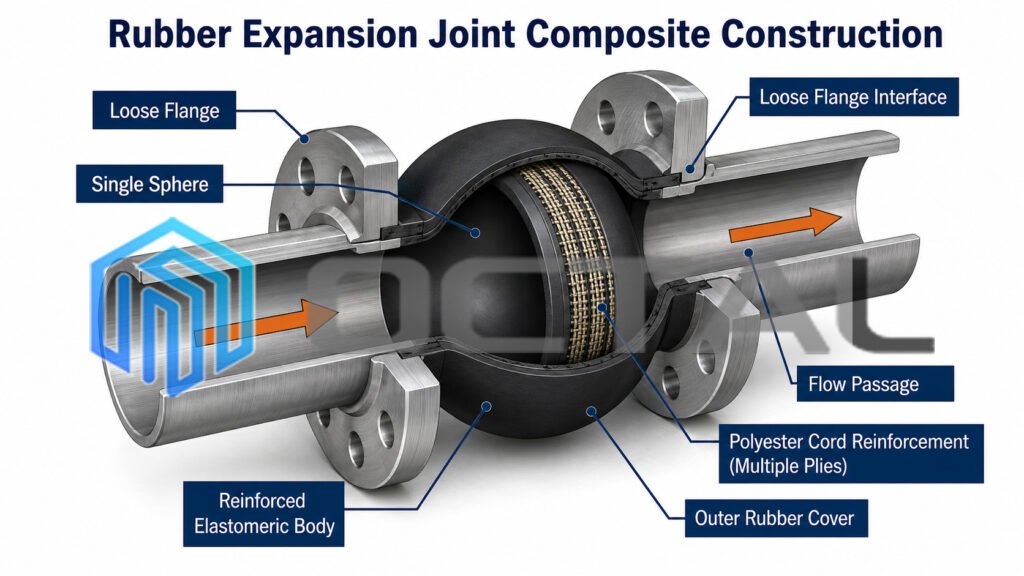
This layered construction is consistent with the general engineering principle used for non-metallic expansion joints: an elastomeric inner tube or lining contains the medium, fabric reinforcement supports pressure loading, and an outer cover protects the structural layers. ASTM F1123 also describes arch-type non-metallic expansion joints using an elastomeric tube reinforced with multiple fabric plies, with additional reinforcement used where required by the design.
EPDM and NBR Rubber Expansion Joint Material Selection
Elastomer selection directly affects whether the joint can remain compatible with the process medium. A rubber compound suitable for circulating water may perform very differently in oil or hydrocarbon service.
The supplied product information identifies EPDM as the preferred material family for water and many polar chemical media, while NBR or another compatible elastomer should normally be considered for oils, fuels and hydrocarbon-containing media.
| Material | General Selection Direction | Typical Engineering Consideration |
| EPDM Rubber Expansion Joint | Water, cooling-water and many polar-media services | Good weather and ozone resistance; hydrocarbon compatibility must be checked |
| NBR Rubber Expansion Joint | Oil, fuel and hydrocarbon-related services | Better resistance to oils and hydrocarbons; water/steam suitability must be reviewed for the selected compound |
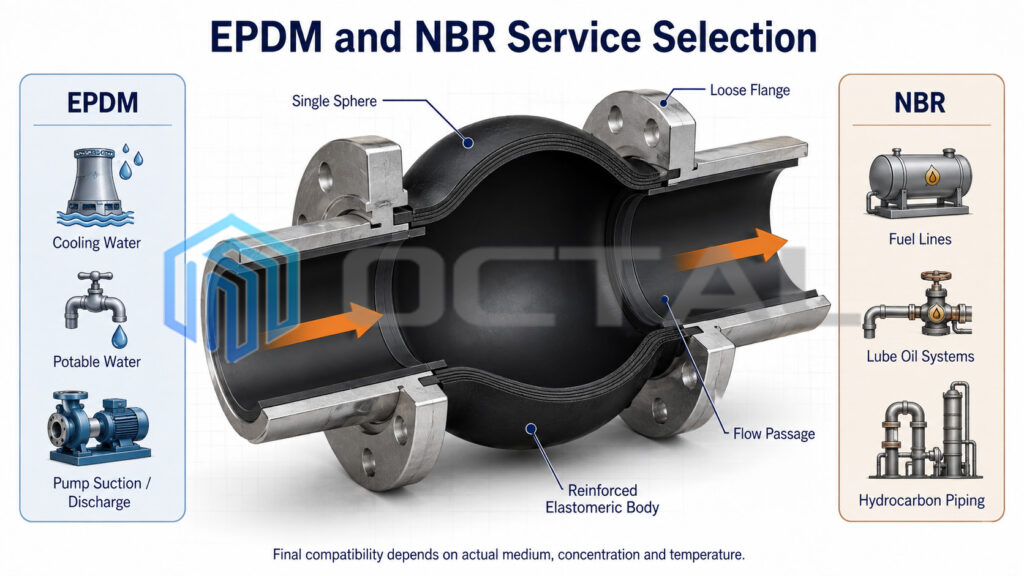
Published elastomer data also show why the material cannot be selected from the product name alone. EPDM and NBR have substantially different resistance to water, oils, hydrocarbons, ozone and temperature, while actual limits depend on the specific compound rather than only the polymer abbreviation.
A purchase specification should therefore state the medium, concentration where relevant, minimum and maximum operating temperature, and any oil or chemical exposure instead of requesting only “EPDM rubber” or “NBR rubber.”
Single Sphere vs Double Sphere Rubber Expansion Joint
A single sphere rubber expansion joint uses one flexible sphere and provides a compact connection where the specified movement can be handled within the capability of that joint.
A double or twin-sphere design introduces an additional flexible section. This can provide a different movement capability, but it should not automatically be treated as a direct upgrade from a single-sphere joint. Required movement, face-to-face space, pressure conditions, piping stability and equipment loads still need to be evaluated against the actual manufacturer’s rated configuration. Industrial suppliers commonly separate single-sphere and twin-sphere designs as distinct product configurations for this reason.
Rubber Expansion Joint Selection Criteria
Selecting an industrial rubber expansion joint starts with the operating condition of the piping system. Nominal diameter determines the connection size, but it does not determine the elastomer, allowable movement or final joint configuration. Medium, pressure, temperature, required displacement and piping restraint must be considered together because each one changes the load carried by the reinforced rubber body.
| Selection Input | What to Confirm | Why It Matters |
| Pipe Size and Flange Interface | Nominal diameter, flange drilling, face-to-face requirement and mating flange arrangement | Determines whether the flanged rubber expansion joint can be installed without forcing or distorting the rubber sphere |
| Process Medium | Water, cooling water, oil, fuel, chemical solution or other process fluid | Controls the inner rubber compound. EPDM is suitable for many water and polar-media services, while NBR is normally considered where resistance to oils and hydrocarbons is required |
| Operating Pressure | Normal operating pressure and design pressure | Internal pressure loads the reinforced elastomeric body and also creates axial pressure thrust that must be carried by the piping restraint system |
| Operating Temperature | Minimum, normal and maximum fluid temperature | Temperature affects elastomer compatibility, flexibility and allowable service conditions |
| Required Movement | Axial compression, axial extension, lateral displacement and angular movement | The joint must provide enough movement capacity for the actual piping displacement without being continuously over-compressed or over-extended |
| Pump or Equipment Connection | Equipment type, vibration source and installation position | Determines whether vibration isolation is an important part of the joint duty and whether additional restraint needs to be considered |
| Vacuum Condition | Positive pressure only or possible negative-pressure/vacuum operation | Vacuum can load the rubber sphere inward and may require a construction specifically designed for negative-pressure service |
| Anchors and Restraints | Pipe anchors, guides, control rods and equipment nozzle arrangement | The flexible joint accommodates movement but does not independently restrain pressure thrust or uncontrolled pipe displacement |
For pump connections, the last point is especially important. A rubber expansion joint for pump piping can reduce vibration transmission, but the flexible body does not remove the axial force created by internal pressure. If the surrounding pipework is not properly anchored or restrained, pressure thrust can move the piping, overload the joint or transfer unwanted force to the pump nozzle.
The final selection should therefore match the joint to the medium + pressure and temperature + required movement + flange interface + restraint condition as one system. Selecting only by DN or NPS may produce a joint that physically fits the pipeline but is unsuitable for the actual operating load.
Rubber Expansion Joint for Pumps and Industrial Piping
Pump Inlet and Discharge Connections
A rubber expansion joint for pump piping can isolate vibration between the pump and connected pipeline while accommodating limited relative movement caused by installation tolerance, thermal effects or foundation movement.
The piping arrangement still has to control pressure thrust and excessive displacement. The joint should not be used as a means of pulling misaligned piping into position, because continuous pre-strain reduces the movement available during operation and changes the loads acting on the joint.
Cooling-Water and HVAC Circulation Systems
Cooling towers, chillers and circulating-water pumps generate both mechanical vibration and temperature-related piping movement. A flanged rubber expansion joint provides a flexible section near the equipment while the elastomer is selected for the circulating medium and operating temperature.
EPDM is particularly relevant to many water-system configurations, subject to confirmation of the actual water chemistry and temperature.
Water and Wastewater Treatment
Water-treatment and wastewater systems use pumps, valves and long piping runs where equipment vibration, installation movement and changing operating conditions can introduce loads into rigid connections.
The joint must still be selected according to the actual medium. Wastewater containing abrasive solids, treatment chemicals or unusual contaminants may require a different compound or construction from a clean-water installation.
Industrial Cooling and Process Utility Piping
Power, metallurgical and chemical facilities commonly contain cooling-water, condensate and other utility lines connected to pumps and process equipment. In these systems, the industrial rubber expansion joint provides a defined flexible interface where movement or vibration needs to be controlled.
The process medium and temperature remain the first material-selection limits. Rubber expansion joints should not be assumed to suit every high-temperature or chemically aggressive process line simply because they can absorb movement.
Installation and Operating Boundaries
The service life of a rubber expansion joint depends heavily on installation condition because the flexible body responds to every displacement imposed by the surrounding piping.
Several points should be controlled during installation and operation:
- Install at the specified neutral length. Excessive compression or extension during installation reduces the movement remaining for operation.
- Align the mating pipe flanges. The joint should accommodate defined service movement, not correct major construction misalignment.
- Avoid uncontrolled torsion. Rotating one flange relative to the other can twist the reinforcement and rubber body.
- Keep flange contact surfaces clean and correctly aligned.
- Protect the rubber surface from welding spatter, sharp edges and external damage.
- Confirm anchors, guides and restraint arrangements before operation.
- Inspect the body periodically for cracking, abnormal bulging, leakage, surface deterioration or flange-area damage.
The Fluid Sealing Association publishes dedicated installation, maintenance and storage guidance for rubber flanged non-metallic expansion joints, reinforcing that installation condition is part of the engineering performance of the component.
Rubber Expansion Joint Standards and Technical Requirements
ASTM F1123 is a standard specification for arch-type non-metallic expansion joints. It defines minimum requirements for their construction, materials, performance and dimensions. The standard covers typical rubber expansion-joint construction using an elastomeric inner tube, multiple layers of fabric or tire-cord reinforcement, and an external rubber cover.
For a rubber expansion joint, ASTM F1123 can therefore be used as an engineering reference for evaluating the flexible body, reinforcement structure and basic performance requirements. It is particularly relevant to the type of reinforced arch or sphere construction used in industrial piping systems.
The applicable standard for an actual order still depends on the specified product and project requirements. For OCTAL STEEL rubber expansion joints, ASTM F1123 should only be stated as a compliance standard when it is required by the purchase specification and confirmed for the supplied configuration.
OCTAL STEEL Rubber Expansion Joint Supply
OCTAL STEEL supplies single sphere flanged rubber expansion joints for pump connections, circulating-water systems and industrial piping where vibration isolation and controlled movement are required. The current reference product is a PN16, 5 in. / DN125 single sphere rubber expansion joint with a reinforced elastomeric body, polyester-cord reinforcement and loose flanges for connection to the mating pipeline.
Rubber material is selected according to the service medium. EPDM is suitable for many water and polar-media applications, while NBR is considered where resistance to oil, fuel or hydrocarbons is required. Final material selection should also consider operating temperature and the actual fluid composition.
FAQ
Q: Can a rubber expansion joint be selected only by pipe size?
A: No. Pipe size defines the connection, but pressure, temperature, medium, required movement, vacuum condition, flange arrangement and piping restraint also affect the final selection.
Q: When should EPDM or NBR be selected?
A: EPDM is generally suited to water and many polar-media services, while NBR is more appropriate for many oil, fuel and hydrocarbon applications. Final compatibility must be checked against the actual medium, concentration and temperature.
Q: Can a rubber expansion joint correct major pipe misalignment?
A: It should only accommodate movement within the specified design capability. Using the joint to force severely misaligned pipework into position preloads the flexible body and reduces the movement available during operation.
Q: What information is needed when ordering a single sphere rubber expansion joint?
A: Specify size, flange connection, pressure, temperature, medium, required axial/lateral/angular movement, vacuum condition where applicable, installation arrangement and required inspection or documentation.